DISCLAIMER: I have no idea where to start on this topic, so like a person riding a bike for the first time without training wheels, I am just going to teeter into whatever lies ahead.
Not too long ago I was driving down a secondary road in Nashville and saw a cyclist dart across the street way ahead of me; he was riding at dusk, super-confident, literally whizzing across a busy intersection with no hesitation. His self-assurance and skill prompted me to think about bicycling. So, here I am.
As I started to think in general about cycling, I remembered something very poignant about a bicycle — something also very funny — from Samuel Beckett’s More Pricks Than Kicks. My most vivid memory from Beckett’s collection of short stories — that center around a unique young Irishman named Belacqua — consists of a madcap, off-road jaunt down a hill that Belacqua takes on a stolen bicycle. Something about the “Whee!” in Beckett’s reference to the bike in that scene had struck me as important. I “Googled” Beckett’s book to find the passage I was looking for in the quickest manner. Instead of getting the relevant passage in the collection, however, I came across a website called Toutfait.com, on which an article by Jake Kennedy had been posted, first in 2005 and then again in 2016. This article is titled “Modernist (Im)Mobility: Marcel Duchamp, Samuel Beckett, and the Avant-Garde Bike.” Kennedy goes into scholarly detail about the various paths the figurative “Bicycle” takes in literature, mostly symbolic, and mostly avant-garde. I just want to tip my cap to Kennedy for his hard work in analyzing the power of the bicycle-symbol in modern life. Moreover, his analysis of the bike’s appearance in that early scene of More Pricks Than Kicks basically sums up why Beckett’s imagery struck me and stuck with me:
Belacqua’s ride literally shakes off his melancholy and it is quite clear that the bike represents…a metaphysical escape from his sadness…
I agree with Kennedy wholeheartedly. However, I want to put my own spin (sneaky suckers, those puns!) on the passage from More Pricks Than Kicks. More than 20 years after reading Beckett’s work, I do not remember much about it, other than that, overall, the book is hilarious. The scene on the bicycle stayed with me after all these years because it not only represents complete freedom, but also a complete rebelliousness: the human itch to fly, to fly in the face of passing scenery, to fly in the face of the air that we breathe, and, at last, to fly in the face of everything else. And not to give a flying you-know-what about it.
When I was young, I had a banana bike, and I understood on some level what that flying-in-the-face of it all meant when I dragged that bike through several neighbors’ yards onto the backstreets behind my house where I could ride in safety. I found a huge hill on those backstreets, and over and over, I would toil up the hill (standing on the pedals) just to enjoy the “Whee!” that I got once I crested the hill and started the descent. Pure madness, fast as I could go, not really needing to pedal, gravity doing its work, no one in my way. Flying in the face of it all.
I suppose when I saw that cyclist darting across the intersection a few weeks ago, the memory of myself at 8 years old, sassy and flashy, at least in the backstreets where no one was really paying attention, set my mental gears in motion.
Indeed, when I was an 8-year-old, with backstreets and parking lots in which to fly in the face of life, I was a confident little cyclist and enjoyed the experience very much. On the other hand, my 11-year-old sister did not have such pleasure. She did not have her own bike and had never asked for one. I am unsure exactly why, except for perhaps this reason: she had known, since probably in utero, that she was not the most dexterous human that would exist on this planet, so she had set some personal limits to her physical activity — limits which made the most of her physical abilities. However, on one particular night, she saw my bike and lost control; she had to cross her limit.
My parents had taken us for an “activity evening” to a nearby school, after hours. This school was a junior high located fairly close to our house, and it sat up on a little bit of a hill. As carpools, buses, and teachers arrived at the school during regular class-time hours, they entered via a parking lot surrounded on all sides by grassy fields. To the left of the parking lot stood the school marquee, proudly displaying the school’s name at the top, and allowing for changing announcements on the aluminum letter-board sign below. My parents usually jogged around the school’s football field, while I rode my bike in the parking lot, and Laura read her book on a low wall heading to the school-building.
Now, at this point, I may be taking liberties with the story, but the way I remember it, Laura saw me flying in the face of the world around the school parking lot and got a little interested in that kind of freedom. So, towards the end of the evening, as dusk settled in and we were all packing up to go home, Laura decided she would give the bike a try.
I let her have it. She got on it — and I do not remember when she learned to ride a two-wheel bike without training wheels, and maybe she had not quite ever done so, but, anyway — she proceeded to pedal away, no soft-pedaling this issue, and went straight off the pavement of the parking lot into the grass surrounding the school. As my parents and I looked on, we thought her charted course looked a little unusual, but, then again, maybe she felt she needed to commune more with nature than stick to a boring parking lot.
Yet, as she carried on further into the distance, her grassy surface began to slant downward — as I said, the school was on a little hill, surrounded by gently sloping grass that eventually ended abruptly into a 5-6-foot bluff that fell straight to the busy street that ran alongside the schoolyard. My father, watching now intently, started voicing some concern. He was saying, almost to himself, though my mother and I could hear, “She’s heading straight toward the bluff….” Before we could shout any warnings out to her, however, Laura realized that she had lost control of everything and that gravity had taken over. I don’t know if she steered herself this way or not, but in her wild “Whee!” (which came out as a scream) en route to the busy street, she veered towards the proud school-sign and plowed, literally, head-on into it. The front tire of my bike made it under the sign, but her face hit the lower slats of it, and with the impact, she was thrown completely off the bike, backwards, into the grass. My bike continued forward for a few feet, then tipped sideways and flopped onto its side. Meanwhile, Laura was supine on the ground, a bit stunned.
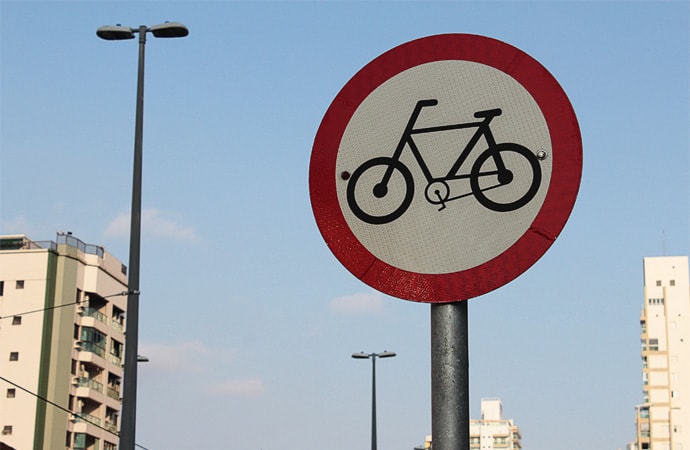
We ran over to her, but she got up and seemed okay. In fact, the school’s sign sustained the worst of the injuries: it had an 11-year-old girl’s profile dented into it at the very bottom, and it stayed that way for years. It was the Sign of the Cyclist — my sister’s profile embedded in the very thing that saved her. She flew into the face of it. And in return, her face was visibly imprinted in the Sign, to show the world that one can, literally, fly in the face of things.